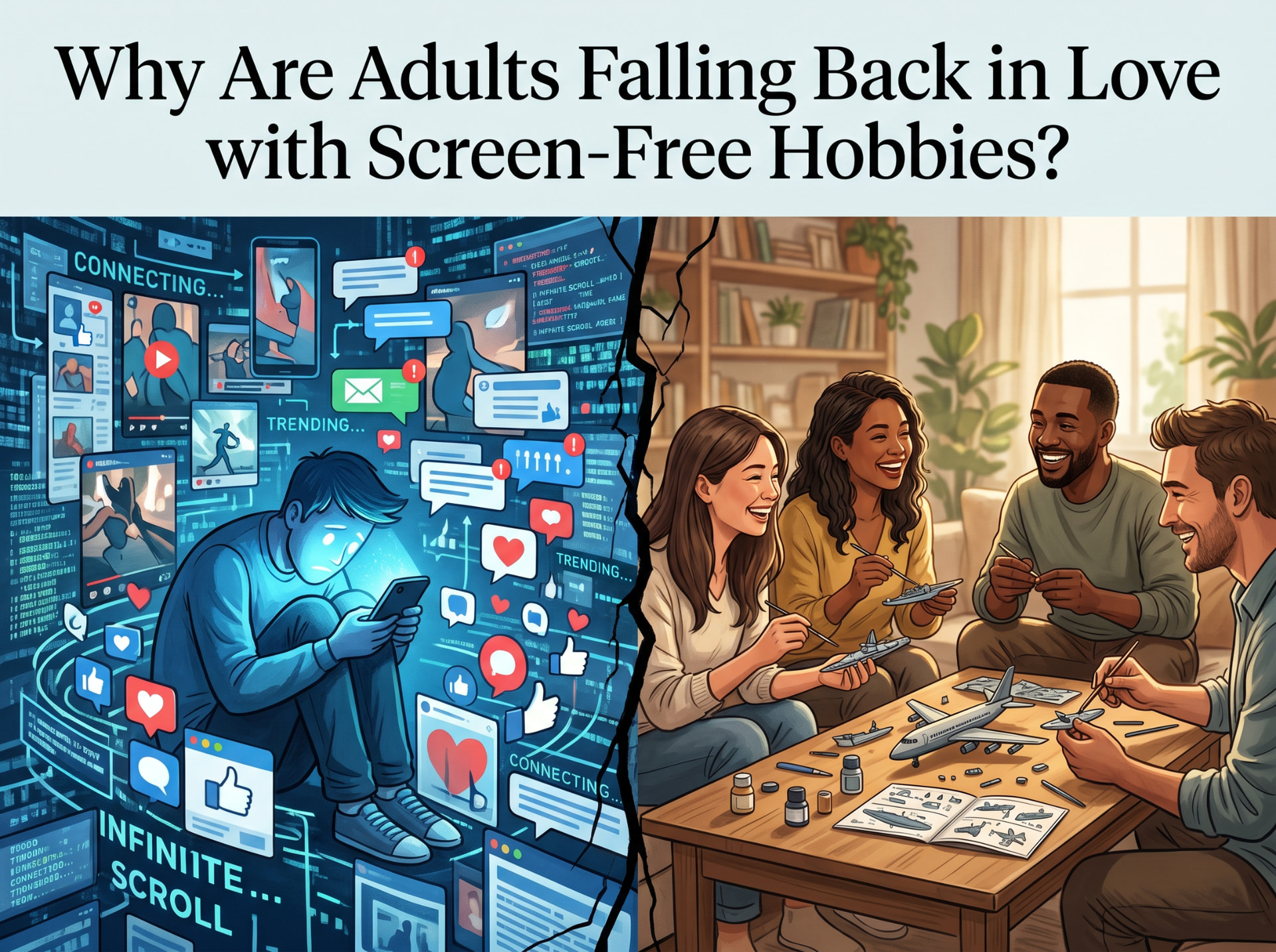


 Our Brains Were Never Designed to Be Online All the Time
For years, productivity has been one of the defining values of adult life. We reply instantly, multitask constantly, and fill nearly every spare moment with information. Social media feeds, short-form videos, notifications, and endless streams of content have made it easier than ever to stay connected, but harder than ever to truly rest.
The human brain was never designed for this pace.
Psychologist Gloria Mark’s research on attention and digital behavior shows that frequent task-switching and fragmented attention significantly increase mental fatigue. (Mark, 2023) This helps explain why many people feel exhausted after spending hours scrolling, despite technically doing very little.
Perhaps that is why more adults are turning toward screen-free hobbies. Miniature building, reading, jigsaw puzzles, crochet, gardening, baking, and board games, activities once considered old-fashioned, are experiencing a resurgence around the world. In recent years, movements such as Slow Living, Digital Detox, and Cozy Hobbies have gained popularity as people look for ways to escape constant digital stimulation.(Honoré, 2005)
What these hobbies offer is something increasingly rare: uninterrupted attention. They allow us to step away from the pressure of reacting to information and reconnect with our own pace.
 Why Screen-Free Hobbies Feel So Restorative
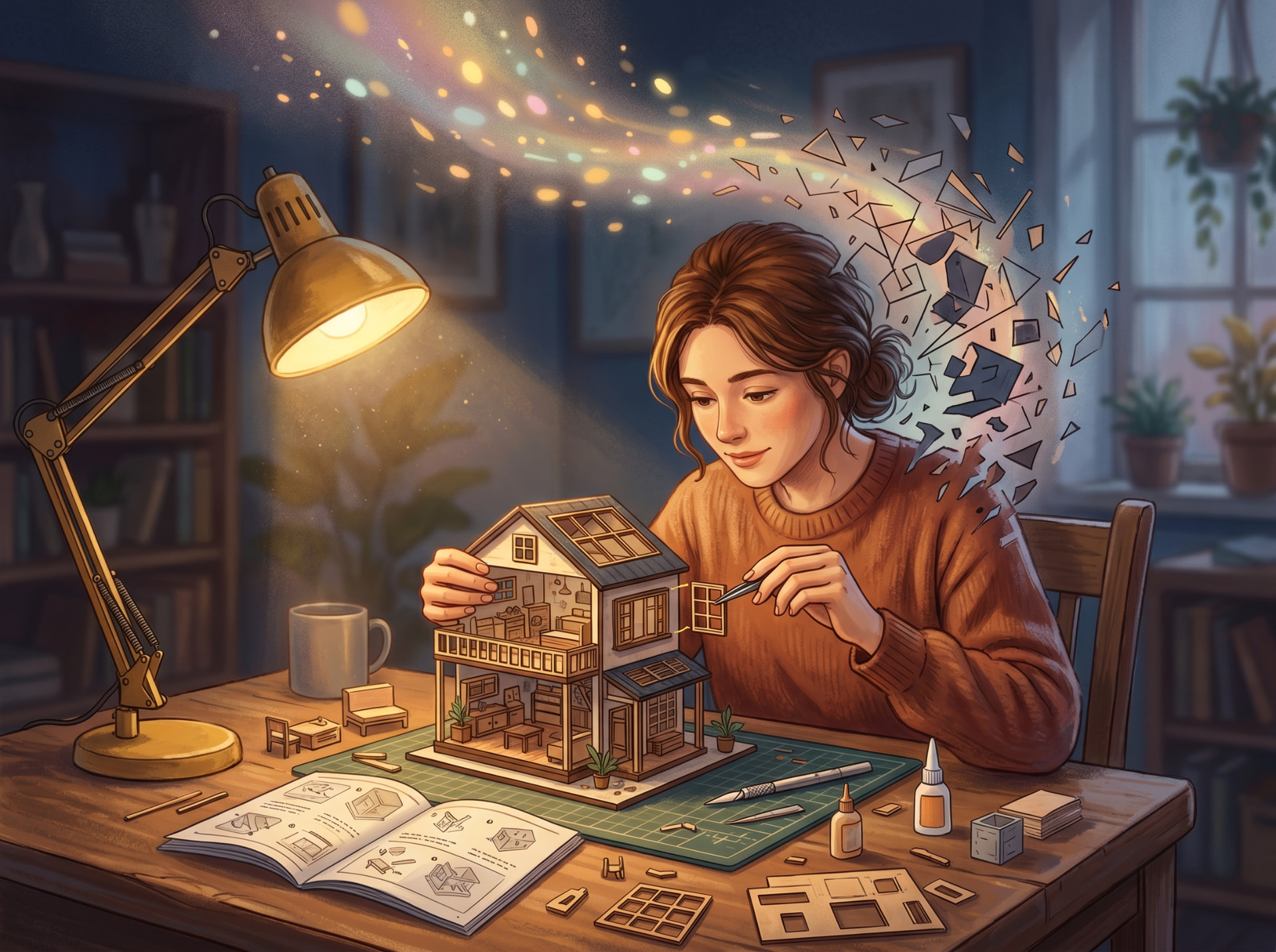
Many people notice the same thing when they begin working on a hands-on activity: the mental noise starts to quiet down.
Whether assembling a miniature house, solving a puzzle, sketching, baking, or caring for plants, these activities engage both the mind and the body. Neuroscience increasingly highlights the importance of embodied experience, the idea that our brains function differently when we are physically interacting with the world around us. (Van der Kolk, 2014)
Much of modern stress lives inside our thoughts. We worry about deadlines, responsibilities, and the future. But when our hands are focused on tangible materials: wood, paper, paint, fabric, or clay. Our attention naturally returns to the present moment.
Psychologist Mihaly Csikszentmihalyi described this experience as Flow: a state of deep focus in which people become fully immersed in an activity.(Csikszentmihalyi, 1990) During flow, distractions fade, self-consciousness decreases, and time seems to pass effortlessly.
Unlike passive scrolling, screen-free hobbies provide meaningful feedback. You can see your progress, touch the results of your effort, and watch something take shape in front of you. That sense of creation can be surprisingly restorative.
 Beyond Hobbies: The Return of Real-World Connection
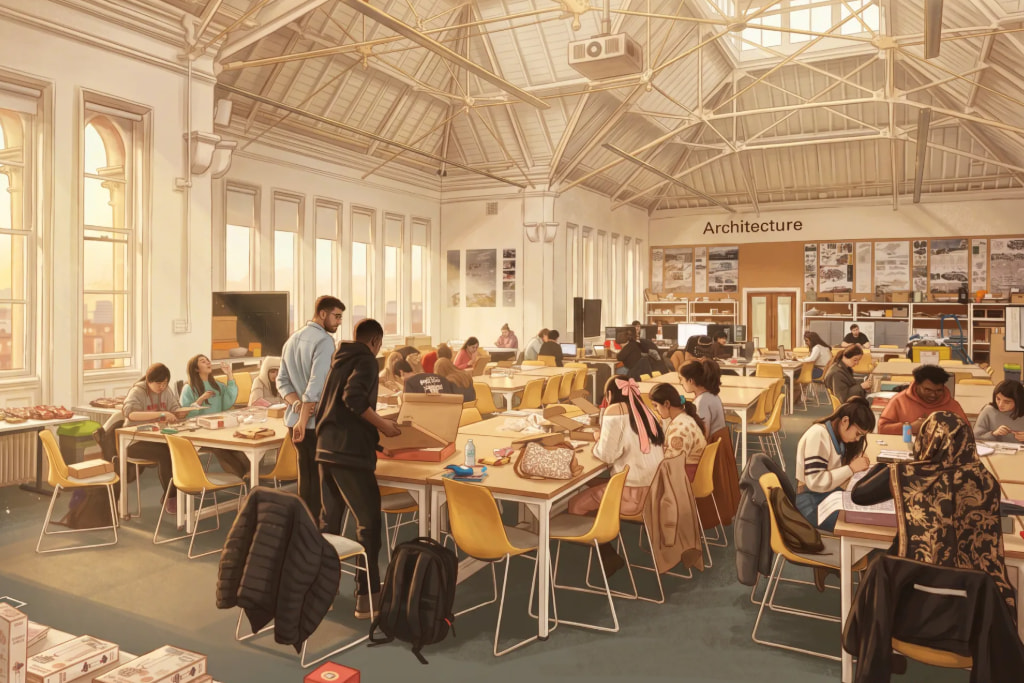
Not all exhaustion comes from work. Sometimes it comes from a lack of meaningful human connection.
Today we communicate with more people than ever before, yet much of that interaction happens through screens. Messages and notifications create the appearance of connection, while genuine companionship often remains limited.
This may help explain why board game nights, book clubs, craft gatherings, dance classes, and local meetups are becoming increasingly popular. Psychologists describe a concept called co-regulation, the idea that our emotional states are influenced and stabilized by the people around us. (Porges, 2011)
Sometimes recovery does not come from solving every problem in our lives. Sometimes it comes from sharing an activity, having a conversation, or simply spending time with people who share our interests.
Sociologist Robert Putnam argued in Bowling Alone that the decline of community participation contributes to loneliness and reduced well-being.(Putnam, 2000) In many ways, the growing popularity of meetups reflects a desire to rebuild those real-world connections.
That is one reason our community has begun organizing local meetups. Whether it’s building miniatures together, sharing creative projects, or simply enjoying an evening away from screens, these gatherings create opportunities for genuine connection in an increasingly digital world.
 What We Are Really Looking For

Modern life constantly encourages us to move faster. Faster responses, faster content, faster results.
Yet many people are beginning to realize that what they need most is not more stimulation, but more presence.
The texture of wood beneath our fingertips. The sound of turning pages. The quiet satisfaction of finishing a miniature project. The laughter shared around a table with friends.
These moments remind us that life exists beyond notifications and endless scrolling.
Screen-free hobbies may not solve every problem. But they offer something increasingly valuable in a distracted world: the chance to slow down, focus on something real, and reconnect with ourselves and the people around us.
References
Csikszentmihalyi, M. (1990) Flow: The Psychology of Optimal Experience. New York: Harper & Row.
 Frequently Asked Questions (FAQ)
Q1: Why do we feel tired even after just scrolling on phones/screens for hours?
A: Frequent task-switching and fragmented attention from digital content cause severe mental fatigue, even if we don’t do physical work.
Q2: Why are screen-free hobbies like model building and puzzles popular again?
A: People want to escape constant digital stimulation. These hobbies bring uninterrupted attention and let people follow their own pace.
Q3: What is the “Flow” state mentioned in the text?
A: It is a state of deep focus. People fully immerse themselves in hands-on activities, ignore distractions, and feel time passing easily.
Q4: Besides mental tiredness from screens, what is another main cause of exhaustion in modern life?
A: The lack of meaningful face-to-face human connection. Most online interactions are superficial and cannot replace genuine companionship.
Q5: What benefits can offline gatherings and screen-free activities bring us?
A: They help us slow down, regain focus on real life, relieve stress, restore energy, and rebuild sincere real-world connections with others.


